
Reviewed · CITY TOURS
Tour Old City/Discover Old Town
Cidade Velha is where Cape Verde’s story comes into sharp focus. Once called Ribeira Grande, it was the first Portuguese city in Africa and an early center for shipping, trade, and the slave trade. You’ll walk among ruins, old churches, and the white marble Pelourinho with the sea close by.
I like the compact route and the chance to see five major sites without spending a full day away from Praia. I also like that private transport is included, and that Nelson is described as warm, funny, and good at keeping the visit comfortable and well paced.
The main caution is consistency. One account describes a cramped sedan and a difficult pickup, while another praises the comfort and guiding. Confirm the meeting point, vehicle, exact duration, and what is included before you set out.
In This Review
- Key points to know before visiting Cidade Velha
- Why Cidade Velha matters to Cape Verde
- Fortaleza Real de San Felipe and the view over the old city
- Se Cathedral and the remains of a former center
- Igreja Nossa Senhora do Rosário and an early surviving church
- The Pelourinho and the hardest part of the story
- São Francisco Convent and the marks of attack
- How the 2 to 3 hour pace works
- Private transport, pickup, and group comfort
- What the price of $29.60 really gets you
- The guide can shape the whole visit
- Who should book this experience?
- Final call: a worthwhile short introduction with details to confirm
- FAQ
- Where does this tour take place?
- How long does the tour last?
- What places are visited?
- Is transportation included?
- Are entrance fees and taxes included?
- Can I cancel for a full refund?
Key points to know before visiting Cidade Velha
- Fortaleza Real de San Felipe gives you the best broad view of the old settlement and explains how the Portuguese tried to defend it after Drake’s attack.
- The tour covers five historic places in roughly 2 to 3 hours, making it useful when your time in Santiago is limited.
- The Pelourinho brings the slave-trade past into public view, so this is not just a pleasant walk through old ruins.
- Private transportation keeps the outing simple, but vehicle size may matter if your group has four people or luggage.
- Nelson is one guide associated with the experience, praised for humor, warmth, pacing, and lunch advice.
- Admission fees and taxes are not included, so allow for possible extra charges at the fort or other paid sites.
Why Cidade Velha matters to Cape Verde
If you want to understand Santiago beyond Praia, Cidade Velha is the essential stop. The settlement was once known as Ribeira Grande and served as the capital of the Cape Verde archipelago for centuries.
Its location helped shape its importance. Santiago sat between Africa, Europe, the Americas, and the eastern trade routes. Ships stopped for fresh water and supplies, while the town became tied to the slave trade. That past is not a side note here. It is part of what made the settlement important and part of what makes the visit difficult.
The remains are now worn and incomplete. You will not find a perfectly preserved old town with every street intact. Instead, you’ll see fragments: a fortress above the town, cathedral walls, an old church still in use as a historic monument, a pillory in the main square, and the remains of a Franciscan convent.
That partial quality is worth understanding before you book. The interest comes from the setting, the age of the sites, and the stories attached to them. If you want polished interiors and a long list of intact buildings, this may feel brief. If you want a direct look at Cape Verde’s early Portuguese period, the route offers plenty to think about.
A few more Praia trips to weigh up
- Praia & Cidade Velha: Guided City Tour
★ 4.8 · 80 reviews - Praia: Baobab Mysterious Tree, Green Valley & Old City Hike
★ 4.8 · 53 reviews - Private Tour Cidade Velha/Discover OLD CITY
★ 5.0 · 4 reviews
Fortaleza Real de San Felipe and the view over the old city
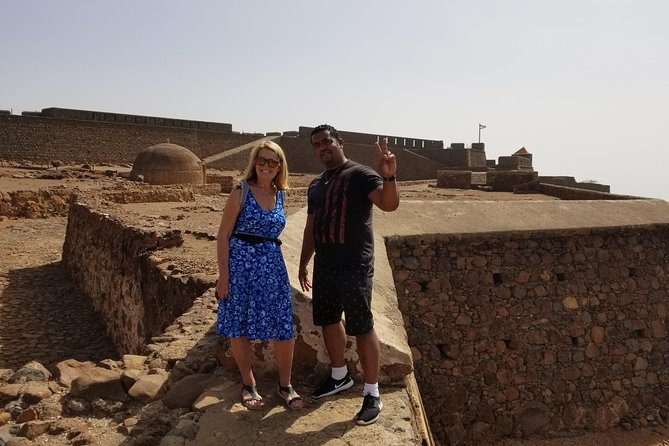
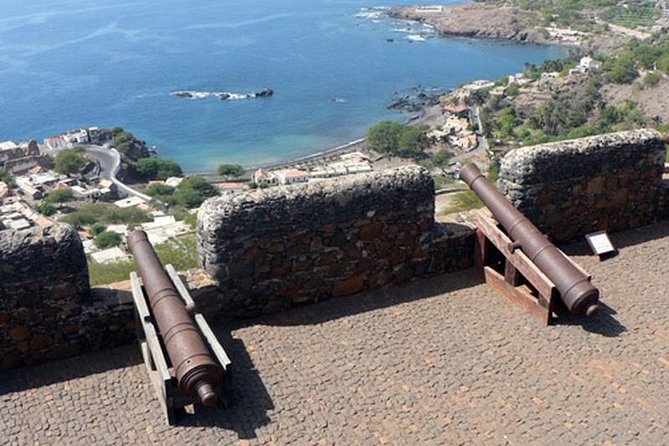
The tour begins with Fortaleza Real de San Felipe, one of the main monuments connected to Ribeira Grande. Construction began in the late sixteenth century, after the English privateer Francis Drake attacked in 1585. The fort was built to guard the town and its harbor area from further attacks.
This is the stop where the setting does much of the work. From the fortress, you can look over the old settlement and toward the sea. The position helps explain why Ribeira Grande mattered, and why control of the town was worth defending.
You should allow about an hour here. That is the longest visit on the route, which makes sense. The fort needs time for its military role, its connection to Portuguese rule, and the wider story of the old capital.
The fort is also a useful place to begin because it gives the rest of the tour a frame. After seeing the town from above, you can better understand the churches, square, and ruined buildings below.
Admission is not included in the tour price. Since the supplied details do not give the exact entrance charge, check the current cost when booking or before departure. The stated price covers private transportation, not all fees and taxes.
Se Cathedral and the remains of a former center
Se Cathedral is scheduled for about 30 minutes. The cathedral was the first one built by the Portuguese on the African continent, though only ruins remain today.
Do not expect a grand intact church. The appeal is in the surviving walls and the scale of what once occupied this place. Preservation work aims to keep these remains from disappearing, and the site helps explain how quickly Ribeira Grande grew after becoming a city in 1533.
The cathedral also points to the town’s wider role. Ribeira Grande was not simply a military outpost. It became a commercial center connected to ships, water supplies, trade, and the movement of people across the Atlantic.
I would pay attention to the contrast between the monumental purpose of the cathedral and its present condition. The broken structure makes the passage of time visible, while the surrounding sea links the site to the routes that brought wealth and suffering to Santiago.
Because admission is listed as free, this stop adds historical weight without another entrance charge. Your guide’s explanation will matter here, since ruins can be hard to read on your own.
Igreja Nossa Senhora do Rosário and an early surviving church
The Church of Our Lady of the Rosary is another 30-minute stop. Built around 1495, it is one of the oldest churches on Santiago and in Cape Verde.
This visit gives you a different experience from the cathedral ruins. Here, the focus is not only on the size of a lost building but on the survival of an early religious site. The church is now protected as a historic heritage site.
One striking detail is its connection to Father António Vieira, who preached here in 1652 while traveling from Portugal toward Brazil. He was surprised to find clergy and canons whose learning, in his view, compared with the best in Portugal.
That detail helps correct the easy assumption that an early colonial settlement was culturally empty or isolated. Ribeira Grande had religious institutions and educated clergy, even as it was also caught up in harsh systems of trade and slavery.
The church is free to enter according to the tour details. Since the visit is short, keep your expectations practical. This is a focused historic stop, not a long church tour with a large collection of art.
Same archipelago, a completely different island day:
- Santiago: Landscapes, Street Art, and Markets Day Trip
★ 4.8 · 316 reviews - From Port of Praia: Island Tour for Cruise Ship passengers
★ 4.5 · 190 reviews - Serra Malagueta: Principal Valley Hike & Lunch with Locals
★ 4.7 · 64 reviews - Santiago: Calabaceira Valley Trek & Visit to Cidade Velha
★ 4.8 · 49 reviews
The Pelourinho and the hardest part of the story
The Pelourinho sits in the main square of Cidade Velha. It is a white marble column in the Manueline style and one of the oldest monuments in Cape Verde, dating from 1512 or 1520.
A pillory represented municipal authority. In this place, it was also connected to the public punishment of enslaved people. That makes it one of the most important stops on the route, even though it takes only about 30 minutes.
The monument was restored in the late 1960s, and the historic center received UNESCO World Heritage status in 2009. Those designations help protect the site, but they do not soften its meaning.
I would not treat the Pelourinho as a quick photo stop. Look at its location in the square and consider what public punishment was meant to communicate. The column represented the power of the town’s authorities, while the enslaved people brought through this Atlantic center had almost none of their own.
This is also where a good guide can make a real difference. The route includes difficult subjects, and a clear explanation is more useful than a rushed list of dates. The available information identifies Nelson as a guide who brings warmth and humor to the visit, but you should still ask how the slavery story will be covered if that subject matters to you.
São Francisco Convent and the marks of attack
The final listed stop is São Francisco Convent, with about 30 minutes set aside. It was built around 1640 on land donated by Joana Coelho, a wealthy landowner and widow of Captain Fabião de Andrade.
The convent was intended for Franciscan religious workers who replaced the Jesuits in the Cape Verde mission. It also served as a training center where priests taught practical crafts to the local community.
That educational role makes this more than a religious ruin. It connects the building to daily life and work in the settlement. The convent was not only a place for worship. It also had a teaching function.
Its later story is rough. A privateer attack by Jacques Cassard in 1712 caused major damage, and a storm in 1754 added to the destruction. As with the cathedral, you are seeing remains shaped by both human violence and natural forces.
The stop is free according to the supplied details. You may find the site less immediately impressive than the fortress, but it rounds out the visit by showing another part of the town’s religious and social structure.
How the 2 to 3 hour pace works
The listed schedule adds up to about three hours: one hour at the fortress and 30 minutes at each of the four remaining sites. In practice, the full outing is described as approximately 2 to 3 hours, so allow for some flexibility.
That short format works well if you are staying in Praia and want a concentrated historical outing. You can see the main monuments without committing most of the day. It may also suit you if you prefer a guided introduction before exploring more of Santiago on your own.
The timing leaves little room for extras. A leisurely meal, a long independent walk, or several unlisted stops would require additional time. One account describes being finished after about two and a half hours and being asked to pay more for other activities. Treat the published route as the core service and ask in advance about any extension.
The tour is private, so only your group participates. That can make questions easier and may allow the guide to adjust the pace within reason. It does not guarantee a large vehicle or a longer visit, however.
Private transport, pickup, and group comfort
Private transportation is included, and pickup is offered. Those features make the trip easier than arranging your own way from Praia, especially if you do not know the roads or want door-to-door help.
The practical warning is the vehicle. One account describes four people being placed in a small sedan and also reports difficulty finding the pickup because there was no promised welcome sign. That is a basic problem, not a minor annoyance, particularly if you are carrying bags or have limited mobility.
At booking, confirm:
- The precise pickup point and how the driver will identify you
- The vehicle type and seating capacity
- The exact start time and expected return
- Whether any entrance fee or tax will be collected separately
- The price of adding time or extra stops
The tour is described as suitable for most participants, with service animals allowed and public transportation nearby. Those details are useful, but they do not replace asking about the vehicle if comfort is important to you.
What the price of $29.60 really gets you
At $29.60 per person, the tour can be good value if you want transport and a guide for a compact visit to Cidade Velha. You are paying for private transportation and the convenience of a planned route through five important sites.
The price is less compelling if you expect a full half-day experience, extensive time at each monument, meals, or every fee to be covered. Admission fees and taxes are listed separately, and the advertised duration is approximately 2 to 3 hours.
Group discounts may improve the cost for larger parties, but check how the discount is applied. Since this is a private activity, the value depends partly on how many people share the vehicle and how comfortable the transport is.
I see the strongest value for first-time visitors who want orientation, historical context, and a simple transfer from Praia. If you already have transport and prefer to explore slowly, you may find the short schedule less useful.
The guide can shape the whole visit
The most encouraging part of the available feedback concerns Nelson. He is described as warm, humorous, comfortable to spend time with, and good at keeping the route well paced. He also recommended a good place for lunch at the end of one outing.
Those qualities matter in Cidade Velha. The sites are close enough to visit in a short period, but the meaning behind them is not always obvious from the stones alone. A guide who can connect the fort, cathedral, church, pillory, and convent will make the route feel like one story rather than five unrelated stops.
At the same time, do not assume Nelson will be your driver or guide. He is a named guide associated with the experience, but guide assignment can vary. The quality appears to depend heavily on communication, so ask for the guide’s name and confirm what language the tour will use if that matters to you.
A good practical approach is to tell the guide what interests you most. You may want more time on Portuguese expansion, the slave trade, religious buildings, or the town’s place in Atlantic shipping. With a private group, clear requests may help you get more from the short visit.
Who should book this experience?
I would recommend it to you if you are based in Praia, want to see Santiago’s most important historic settlement, and prefer a private car over organizing transport yourself. It is also a sensible choice for a first visit, since the route covers the main landmarks in a logical order.
It suits people who enjoy ruins, colonial history, fortifications, and difficult but necessary subjects. The Pelourinho in particular makes this more serious than a simple old-town outing.
You may want a different plan if you need a spacious vehicle, want a full five-hour program, or hope to spend a lot of time wandering independently. The short duration and possible extra charges for added activities should be clear before you pay.
Book only after confirming the pickup details and vehicle size. Also remember that the experience requires good weather. If poor weather cancels the tour, you are offered another date or a full refund.
Final call: a worthwhile short introduction with details to confirm
Book this tour if you want an efficient, private introduction to Cidade Velha and value having transport arranged from Praia. The fortress, cathedral ruins, old church, Pelourinho, and convent give you a strong outline of Santiago’s early colonial story in a manageable two to three hours.
I would not book it blindly. Confirm the meeting point, vehicle, duration, entrance costs, and policy for extra stops. If those points are settled, the tour offers a useful balance of convenience and serious historical content, with the chance of a particularly personable guide such as Nelson.
FAQ
Where does this tour take place?
The experience is based in Praia and visits Cidade Velha, also known historically as Ribeira Grande, on Santiago Island in Cape Verde.
How long does the tour last?
The stated duration is approximately 2 to 3 hours. The planned stops include one hour at Fortaleza Real de San Felipe and about 30 minutes at each of the four other sites.
What places are visited?
The route includes Fortaleza Real de San Felipe, Se Cathedral, Igreja Nossa Senhora do Rosário, the Pelourinho, and Convento de São Francisco.
Is transportation included?
Yes. Private transportation is included, and pickup is offered. The activity is private, so only your group participates.
Are entrance fees and taxes included?
No. All fees and taxes are excluded. Se Cathedral, Igreja Nossa Senhora do Rosário, the Pelourinho, and Convento de São Francisco are listed with free admission, while the fortress does not include an admission ticket.
Can I cancel for a full refund?
Yes, if you cancel at least 24 hours before the experience starts. Cancellations or changes made within 24 hours are not refunded or accepted. If poor weather causes the operator to cancel, you are offered another date or a full refund.
Just added around Praia
- Hiking Águas Belas Cave★ 4.5 · 3 reviews
- Santiago Island: 4-Hour Calabaceira Valley Hike & Guided Tour to Cidade Velha★ 5.0 · 18 reviews
- Tarrafal Beach Tour: Boat Trip to the Lighthouse, Snorkel & BBQ Lunch★ 5.0 · 5 reviews
- Santiago Island: Private Airport Transfer to Praia or Vice Versa★ 5.0 · 3 reviews
- Best of Santiago Island: Cidade Velha, Workshop & Tarrafal Beach Tour★ 4.5 · 3 reviews
- Private Tour of Santiago – Discover the Island★ 4.5 · 18 reviews
- Santiago Island: Banana Plantation, Natural Park & Workshop with a local family★ 5.0 · 10 reviews
- Ribeira da Barca: Boat Trip to the Cave, Snorkeling and BBQ on the beach★ 5.0 · 10 reviews
City Tours, compared.

Espargos City Tour, Local Life, and Cape Verde Tapas
Read our review →
Beaches, Villages and Monte Verde (excludes city)
Read our review →
Baobab Mysterious Tree, Green Valley & Old City Hike
Read our review →
Santa Maria City Tour & Cuscuz Tasting with a Local Family
Read our review →
Browse the lists this tour appears in